Cream Kitchen Cabinets: A Buyer’s Guide
Cream kitchen cabinets suit both traditional and modern rooms, but the shade you choose has to work with the worktop, backsplash, floor and light. This guide sets out the decisions to settle before you request a quotation.
Cream Kitchen Cabinets: A Buyer’s Guide
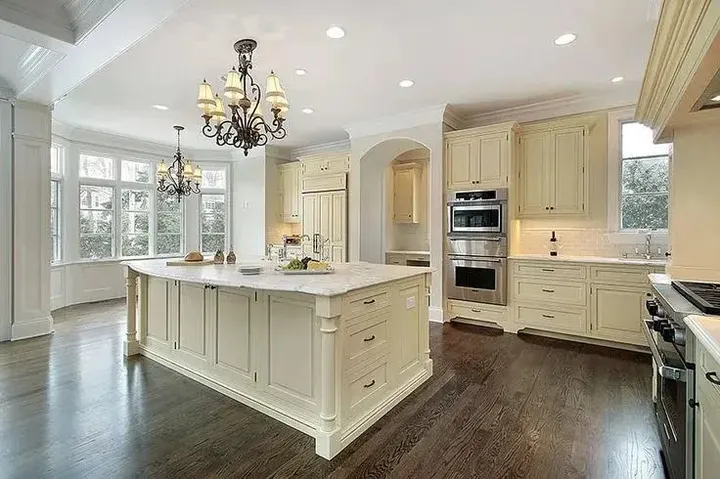
Cream kitchen cabinets sit between white and beige: warm enough to soften a room that gets little daylight, light enough to keep a small kitchen bright. Before fixing a shade, settle the planning points together: the undertone of the cream, the door style, the finish sheen, the hardware, the countertop, the backsplash, the flooring, and how the room is lit by day and after dark. George custom kitchen cabinets are made to order, and design, color, material and size are confirmed for each project.
Door style and finish carry most of the visual weight. Shaker doors give a clean frame-and-panel look that suits period and contemporary rooms, slab doors read more minimal, and raised-panel doors add traditional depth. Painted wood and lacquer give an even color with a soft sheen; melamine and veneer give a harder surface for busy family kitchens. Hardware in brass, bronze, black or brushed steel changes how warm or sharp the cream looks, so hold the handle against a sample door before deciding.
Countertop, backsplash and floor are best chosen as a set with the door color, because cream shifts against every surface beside it. The kitchen cabinets category page sets out the range, and the inquiry form is where a project starts.
Kitchens with Cream Cabinets
A cream kitchen reads calm only when the whole room is decided together. Choose the cream undertone alongside the wall color, worktop, backsplash, flooring, hardware and lighting rather than item by item. Decide first whether the cabinets are the tonal base of the room, with walls a shade lighter and surfaces slightly deeper, or a contrast element set against a stronger wall or floor. That decision guides every later choice.
Layout and storage planning run alongside the color work. An island carries the same cream as the run behind it for a quiet, unified room, or a deeper shade to ground the center of the floor plan. A pantry cabinet in the same finish keeps the elevation continuous, while open shelving or a glass-front section introduces a break. Settle the mix of tall, base and wall cabinets before colors are fixed, because a change in cabinet height or depth alters how light falls on the finish.
George custom kitchen cabinets are made to order, and color, material and size are confirmed for each project, so an island, a pantry run and the main elevation can be planned as a single set. The kitchen cabinets page covers the range, the kitchen island page covers island planning, and the inquiry form is where a layout becomes a quotation.
Farmhouse Cream Kitchen Cabinets
Farmhouse style is a set of planning choices rather than a fixed package. The door profile sets the tone: a frame-and-panel shaker door with a beaded edge, a plain center panel, or a taller raised panel. Hardware can stay plain in black or bronze, or use cup pulls for a period feel. Finish matters as much, with a soft-sheen paint reading traditional and a flatter matt paint reading quieter. Each of these is an option to confirm in the quotation.
On a farmhouse layout the island usually takes the same cream as the main run, with a deeper or timber-toned worktop to carry the weight of the room. Pantry storage works well as a full-height run in the same finish, with internal drawers, pull-outs and adjustable shelves agreed at design stage. Plate racks, tray dividers and deep drawers are chosen per project. George custom kitchen cabinets are made to order, with design, color, material and size confirmed for each project.
The kitchen cabinets category page sets out the options, kitchen cupboards covers storage planning, and the inquiry form is where a brief becomes a quotation.
Pairing Cream Cabinets with Walls, Worktops and Lighting
Cream sits comfortably with warmer walls, mid-tone worktops and natural floors. Walls a shade lighter than the cabinets keep the room open, while a deeper wall color makes the cream read lighter and adds depth. Warm whites, soft greys, muted greens and pale timber all hold their own beside cream. Saturated wall colors need more care, because they change how the cabinet doors read under artificial light. Test each pairing in the room at different times of day.
Worktops and backsplashes do more for a cream kitchen than any other surface. Mid-tone timber, warm stone and honed pale surfaces keep the scheme soft, while a darker worktop gives the cream something to sit against. The backsplash follows the worktop: a plain field tile keeps the room quiet, a veined stone or a hand-glazed tile adds movement. Under-cabinet lighting lifts the splashback and shows the true tone of the door finish after dark.
Ordering Cream Cabinets: From Layout to Quotation
An order starts with the room, not the color chart. Send the kitchen layout, wall measurements, the style and material direction, and the appliance sizes that have to fit. George provides 2D and 3D model design and product selection for kitchen projects, and the quotation confirms sizes, materials, hardware, minimum quantities, lead time and shipping.
- A plan of the room with wall measurements.
- Door style and color direction, with reference images if you have them.
- Cabinet material preference: solid wood, particle board, MDF or plywood.
- Hardware preference, including Blum or DTC options.
- Island and pantry requirements, plus appliance openings.
Accepted payment methods include L/C, T/T, PayPal and Western Union.
Request a quote
Planning a kitchen? Share your layout and sizes and George will reply with cabinet options and a quotation.
Or write to sales@kitchencabinetsfromchina.com